
I love old forgotten stuff. Hiding in overgrowth or tucked behind an old barn, these artifacts are the coolest things to me. I love the mysteries they offer in the stories that they hold – the way they wait patiently for someone to stumble on them and stand in wonder.
A love for old things is part of my heritage – passed on from my mom and dad. My mother is an artist and as a child I used to drive all around the Oregon countryside with her looking for covered bridges or old barns to paint. We’d park nearby, get out and just gaze at these abandoned buildings – a sense of awe and wonder carried on the breeze. We waited for the light to be just right and tried to capture the perfect combination of shadow and color in our minds.
My dad is the same way. He loves old farm machinery and pioneer wagons the way others might covet a fancy sports car. A collector and a detective, my dad wades into the deepest parts of old barns, uncovering pieces of metal in the dirt and piecing together an old mower, stone tool sharpener, or mule harness. His favorite question is, “can you guess what this is?” Its crazy, but no matter how obscure something piece of iron is that he finds, he can always identify it and piece together where it all used to fit.
Thus, I’m used to taking a closer look at old things. As my mom and dad used to tell me:
Stop for a minute, Hanna. Put your hand on these old walls, these decaying timbers. Feel the texture and grit, what someone else centuries before would have felt standing in this same place. Listen to the sounds the walls make when the wind blows outside. Squint up and see if you can’t just make out something that others can’t see. Isn’t that thrilling?
And they were always right. It is thrilling.
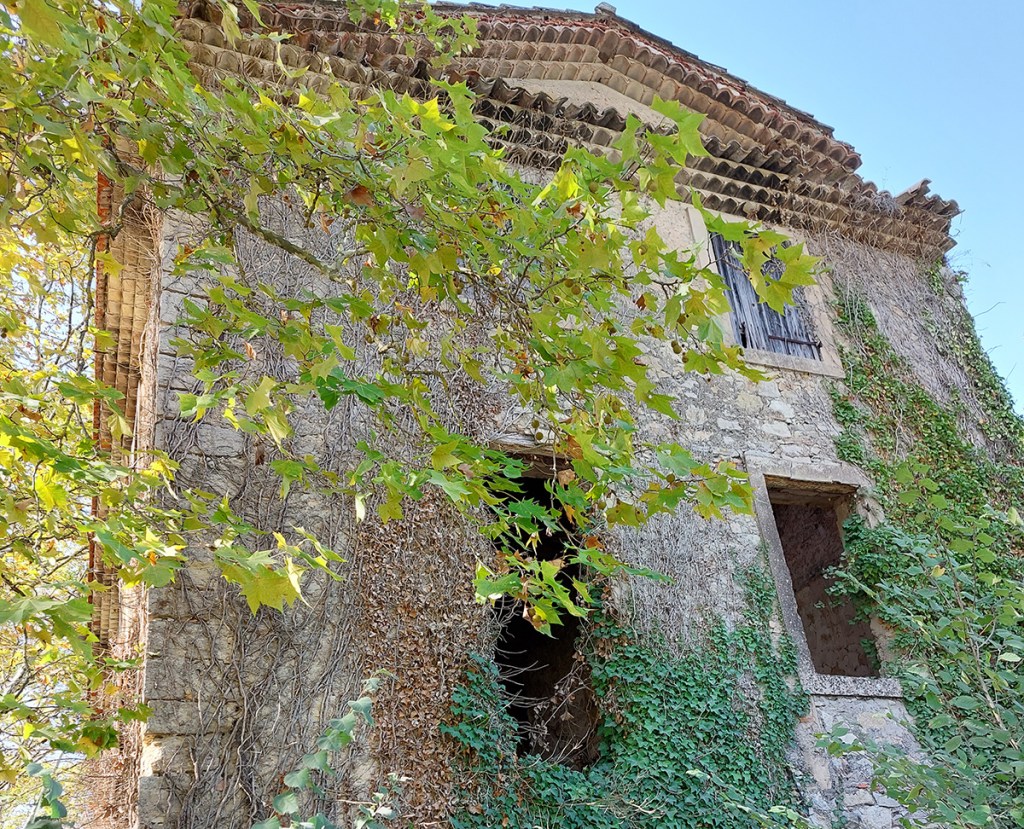
If I turn off the radio in the car or decide against listening to a podcast on my walk – if I am attentive – I discover these abandoned places everywhere here. It’s true that civilizations have inhabited the south of France for thousands of years, building aqueducts, mills, barns, and monasteries. These people have come and go through revolutions, wars, and famine – making their mark and then leaving it behind for the next. Maybe that is why everywhere I turn there is something unidentified in the fields or hedges.
As commonplace as these may be, I feel honored to stand witness to these sacred spaces. It feels like unwrapping a sweet surprise when I notice something out of the corner of my eye. Maybe half covered in the dirt – an oddly stacked set of stones covered in creeping ivy. Upon closer inspection I can see the outline of a tiny step or curved structure. If I stand back and connect the dots I can almost imagine what used to be there.
Then the questions begin to take shape in my mind and my imagination takes flight: Who built this building – what was its purpose? Did a family live here? Can you hear the laughter of the children as they ran past this wall? Can you see the bustle of people going about their busy days with this structure as a backdrop? Why was it abandoned? Did the people run out of money – meet hard times, hunger or war? Did the next generation move on to something else?
On a recent hike, Bobby and I found the ruins of what appeared to be an old manse tucked in some trees to the side of the trail. All that was left was a bit of foundation and few walls with a partial window opening. It must have been a large structure as bits of old stones dotted the space. In one area we fund an almost fully standing domed wood oven. The stones had crumbled in places and it was covered in detritus from the forest, but the archway with its keystone and the oven floor stood strong and true.

I’m a bread baker and I love the history and evolution of baking. So this old oven really beckoned me. I made Bobby wait for a while so I could listen for the stories that this oven wanted to tell. Stories of days long gone when its cook would wake early to stoke the fire to the right intensity. When a few loaves of bread were being kneaded on the long wooden tables that must have stood nearby. When someone was beating eggs in an old pottery bowl for a cake or a mouse or a sauce. When children milled around the side door – drawn by the smell of baking pizza or fresh rolls, waiting to sneak a taste as they were set out to cool. When meats were cured in a smoke house outside from the recent hunt. When herbs hung in bunches from the old pine beams overhead. When the heat from the open fire was overwhelming on a hot summer day – and simply delicious when the weather turned cold. I could have stood there for hours.
And that’s just the thing – these old buildings don’t care how long you stop to stare. They have all day and are happy for you to bask in their shadows for some shade or wait to capture them in just the right light.
We all love to find things that we thought were lost. But what if we find something we didn’t even know we had lost? That is the thrill that keeps me careening around the corners of overgrowth again and again.

Old ruins connect me to a time long gone. They remind me that time passes – we pass – and what we think will stand the test of time often doesn’t. It’s these ancient stoic bricks or partial stone foundations, maybe an iron well pump or a decaying pulley that are all that remain when time has washed away the sum of us.
And yet as humans, we are all brothers and sisters joined together by the desire to survive and thrive – to leave our marks and bring some meaning to the years we have on this planet.
So, we honor not just the stones in the dirt but also the souls who stacked them, the generations that sought shelter under these roofs, and those who will someday stumble on them again to ponder what all of this means.
Bisous,
Hanna


One response to “Choses Oubliées”
Your findings are marvelous and your thoughts are wonderfully inspiring.
I can feel them.
LikeLike