

We are still in winter here. Specks of spring abound, but not as prominently as they will be in a few weeks’ time. Flowers are emerging, adding color and texture to our village. Birds are warming their voices in the sun. But the evenings are still crisp and grey at times and the rains seem to come and go.
As we make our way to another late football entrainment (soccer practice, for us Americans!) the Stade Leon Chabert rises tall against the dim light. Its brilliant green turf, well-manicured and marked with bright white and blue lines looks fresh and modern. With the four large stadium lights lit, the Stade seems luminescent – brought to life by calls and laughter of children on the pitch.
In the corner of the field stands the scoreboard, dutifully marking the hour. It flashes 18:46 in bright red neon lights. One of the team sponsors, Carrefour Market, has prominent placement along the top of the board. And while this is a training night only, the promise of goals for the “Locaux” and “Visiteurs” creates excitement for the young players racing around the pitch.

The Stade Leon Chabert is the home of US Valbonne, one of many football clubs in the area. This is France after all, where children play football as soon as they can walk. You’ll see young kids, maybe 6 or 7, doing rainbow flicks over a defender and goalies diving fully-outstretched for saves without even blinking. It’s in their blood.
Amid a sea of flashy football teams, US Valbonne stands apart as a club with a storied history. This year marks its 75th anniversary, having started in 1948 as Europe was emerging from World War II. Young men recently back from the front were looking for a return to some normalcy. With family gone, old stone buildings laying in ruin, and lives disrupted the familiar touch of the football must have felt like a salve to their wounds.
In my history classes, WWII in France focused on the landing of Allied Forces in Normandy and the occupation of Paris, with a light touch on the impact of the pro-Nazi Vichy regime. However, I didn’t study much about the rest of the country, let alone understand life in Nazi-occupied southern France.
But as she does with many things, southern France has been slowly revealing her tumultuous story to me, one piece at a time – a tiny hint here or there.
I will see something out of the corner of my eye and wander over to read a surprising inscription on a grave marker or simple stone.
Crumbling structures, overgrown in the woods appear out of nowhere, and I will spend hours online trying to discover what they had been.
A tiny plaque hanging over an unassuming door in our village catches the light and I will learn about a courageous female resistance fighter named Lucienne Gerard, who battled the Nazis as a teenager[1].
A memorial to “heros sans uniform” lay on a forgotten side street behind a patriotic garden of blue, white, and red petunias.
Near the Confiserie Florian, I walk by a tiny, unattended room to find a few obscure photos showing Nazi’s use of the candy factory as a local headquarters. Next to them is a small write up about how, as Allied forces approached, the German’s blew up the beautiful old viaduct overhead to disrupt transportation.

Southern France has more to tell then has been written about her. As I’ve discovered, after the Nazis defeated France in 1940, they agreed to an armistice that split France into regions. The south was presumed to be “free” territory and under the control of the Vichy government. “Free” was more of a loose term, as anti-Semitic policies and repressive programs made life miserable for many. In 1942, the demarcation line was eliminated and German and Italian Axis forces occupied all of France[2].
For civilians here, life became challenging to say the least. Mass deportations of Jews and political opponents commenced – most would never return. Nazis requisitioned food, supplies, and animals – carting off what they needed to support their war. They instituted a wide-sweeping draft of local men and boys as young as teens as laborers for the Reich[3]. All of this fueled the French resistance movement under the exiled leader Charles de Gaulle.
Resistance fighters were on the ground right here in these small villages fighting for freedom. They smuggled information, supplies, and weapons. They stole valuable stamps to buy food and clothing for soldiers and people interned in concentration camps. They helped Jewish children escape during nightmarish round-ups and hid them in local homes. They disrupted German transports and destroyed rail lines. And they took up arms against Nazis and their sympathizers. And they stood side-by-side with Allied forces when they came to liberate southern France in August of 1944[4].
I am not sure how to put this into words, other than to say I am speechless and in awe of their courage and tenacity.
Back at Stade Leon Chabert, I wander into the team canteen for a bottle of water. Off to one side hanging on a cork board are black and white photos, photos of the inaugural team in 1948. I gaze at the faces of the coaches and players – 20-something men with proud smiles for this new team they have created. And I wonder what sits behind those smiles? What have these eyes seen, what have these hands experienced, what was the story of their lives a mere 5 years before?
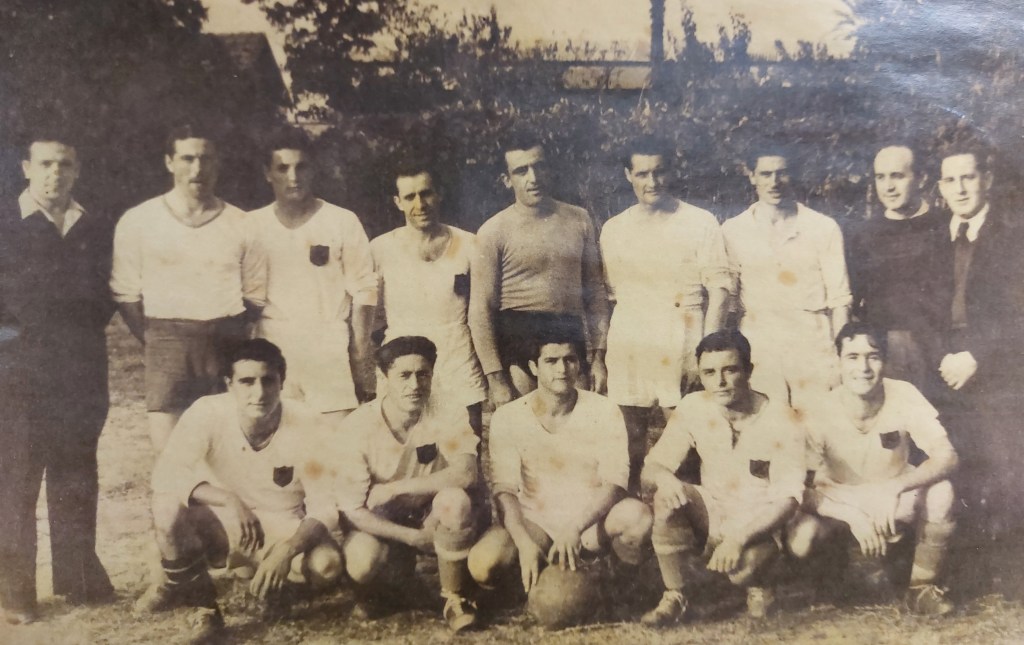
And these are the lucky few who returned home; who, like most people on this side of the Atlantic, faced sad truths about what was left of their friends and families and then had to figure out how to start over again.
So, they built this team and then they built this field. They put their tragedy and their triumph out on the pitch. They banned together and rediscovered what it felt like to play.
And in their first season, they won the championship of the Côte d’Azur region.
At the occasion of their 50th anniversary, the cofounder M. Léon Chabert told the crowd (translated),
“Football has long held an important place in our community. In February 1948 accompanied by many young people who asked for the creation of a football club, the USV was created…there were certainly pages of glory…but also dark years.”[5]
My father-in-law, Dr. John Benfield, teaches a class at Loyola Marymount University in Los Angeles. While many have documented the horrors faced by Jews during the holocaust, John has chosen to focus on the resilience of Jews and refugees in exile. Himself a refugee from Austria, he knows first-hand the choices that shape our lives. He uses this experience to highlight poignant examples of people who have adapted their pain to create new stories. Instead of being held back, they are propelled forward with determination. They build something magnificent from ashes and rubble.
I sit here now, in 2023, and watch my young sons practicing on this field. They are products of that resilience and determination. At 10 and 13, they have no concept of a world at war, let alone war in their own back yard. They haven’t needed to be hidden away or watched as their friends and family disappear. They haven’t faced hunger or fallen asleep to the sound of distant gunfire.
Sadly, countless children have and many still do.
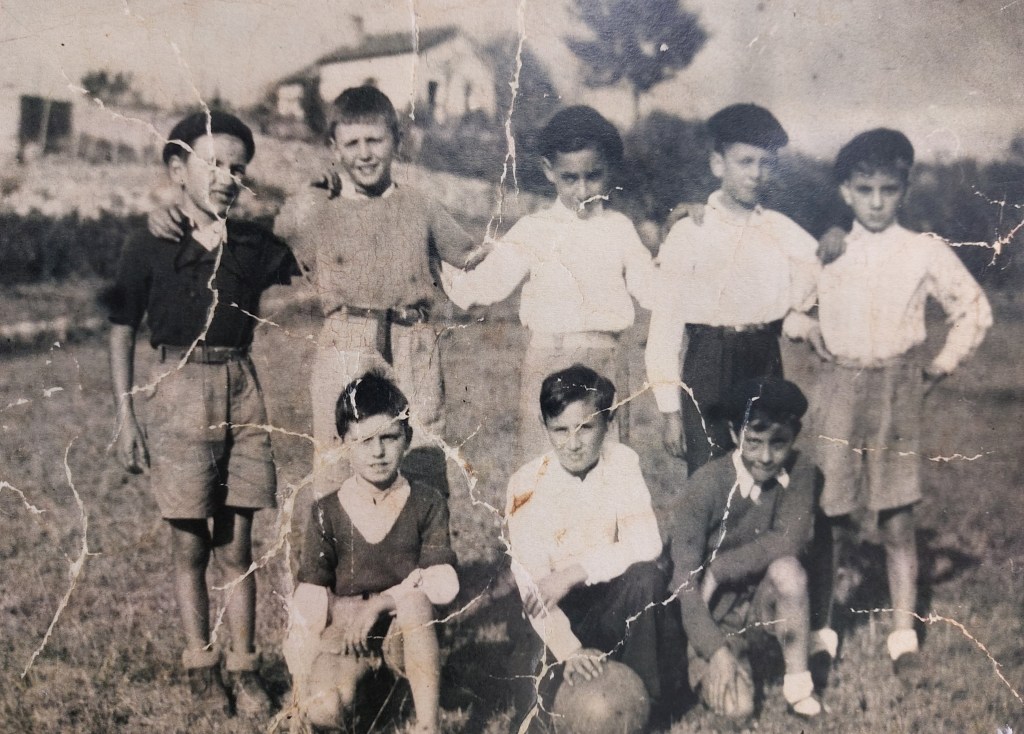
And so, to honor them we push forward to defeat those things that seek to defeat us. We decide never to forget the past that has shaped us, but also to carry the torch forward with renewed vigor. And along the way, we choose to find the time to laugh and play…and leave it all on the pitch.
Bisous,
Hanna
[1] Testimony of Léon Gendrot. 11 September 2017. “Lucienne GERARD, Combattante volontaire de la Résistance.” Mémoire de Guerre. Accessed 30 March 2023. [http://memoiredeguerre.free.fr/biogr/gerard-lucienne.htm]
[2] Fontaine Thomas, Chronology of Repression and Persecution in Occupied France, 1940-44, Mass Violence & Résistance, [online], published on: 19 November 2007, Updated 17 May 2021, Accessed 28 March 2023, http://bo-k2s.sciences-po.fr/mass-violence-war-massacre-resistance/en/document/chronology-repression-and-persecution-occupied-france-1940-44, ISSN 1961-9898
[3] Rosbottom, Ronald. Sudden Courage: Youth in France Confront the Germans, 1940-1945. Custom House. 13 August 2019.
[4] Chen, Peter C. “The French Resistance, 22 Jun 1940 – 28 Aug 1944” [online] World War II Database, published and updated in May 2006, Accessed 27 March 2023. https://ww2db.com/battle_spec.php?battle_id=153
[5] Chabert, Léon. Address to Crowd celebrating 50th Anniversary of US Valbonne. “Un demi-siècle de football.” Nice-Matin. 31 December 1999. Translated.
 40 Weeks in France
2 responses to “Comment on marquez le temps”
Well spoken, my dear. These realities make our American history classes insufficient and shallow. The war in Ukraine exposes isolationism and idealism as vain and shallow, as well. Our own geography affords us the arrogance to assume we are immune and can stand aloof….but while I can’t cite the source or verbatim, isn’t it along the lines of, in order for evil to succeed, it only needs good men (and of course, women) to stand by and do nothing.
You might be interested in reading The Splendid and the Vile…..you will never see England/Great Britain in the same way again. For lighter reading, but every book brings forward pieces of what you are learning/experiencing – Bruno, Chief of Police, wonderful series by Martin Walker. It is situated in the Perigord (?). The author lives part time in the region. The main character’s name is Benoit Courrege (sp?), otherwise known as Bruno.
Is the unrest re: raising the retirement age impacting much where you are? Are the strikes, etc. happening there? Enjoy watching your sons exhaust themselves in the joy of physical exertion, I miss it sometimes….M
LikeLiked by 1 person
Thanks, Maggie! Great insights…yes, it is sad the way the exciting world of history is taught. Just learning dates, battles, and political figures takes all the fun away. You lose the human element and we are taught that history is compartmentalized. The interconnectedness of life disappears.
I read the Splendid and the Vile – it is a magnificent book! Doesn’t show the US in a good light, but I think that’s more the truth than what we have been raised to think. I’Lom reading this book now called Sudden Courage: Youth in France Confront the Germans, 1940-1945. It highlights how younger French people (adolscents up to mid-20s) came to understand Nazi aggression, internalized the confusion of their parents, and used whatever means they could to support the resistance movement. So far it’s a good read.
I love Bruno! I think you recommended it to me when we were in Virginia and I started the first one, but I don’t think I finished it…so I need to restart that. That’s my issue…I start reading too many books! 🙂
The “greves” or strikes are everywhere, but the protesting seems to be in the bigger cities. We are too small for it to affect us too much…other than delayed flights and canceled trains…and the occassional inability to get gas. Alas. But we are traveling to Paris today so we’ll see what that is all about and I’ll report back.
Any chance we can lure you to France? We are staying another year here and we have plenty of space for a visitor! Sending much love!
LikeLike