
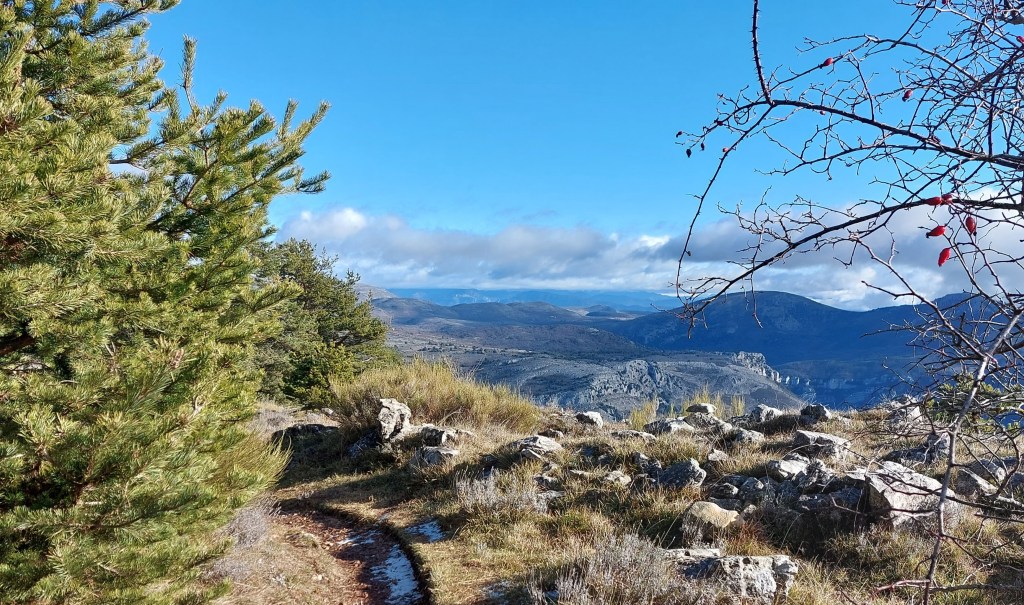
We hiked in silence today. 35 degrees and gusting winds will do that to a person. Better to tuck your ruddy cheeks into your scarf, pull your hat down a bit lower on your head, and lean into the trail.
Hiking in silence does more than conserve your precious heat. It also expands your senses. You become aware of the whispers of the pines as the wind whips through, attuned to the ebb and flow of the mountain as you climb, able to relax into your own heavy breathing as the hill steepens.
As they say, Silence is Golden.
It snowed lightly in our foothills this past week, but with warmer daytime temperatures the coverage is hard to see from our village. We were frankly surprised to discover light dustings of snow on the trails and roads side, which deepened the further we drove.
It made for a rather slippery, brisk start to our hike for sure.
Keeping my head bent forward amid the gusts, I became fixated on finding various little tracks in the snow. Tiny footprints of animals that had passed along the same route maybe that morning or late in the night.
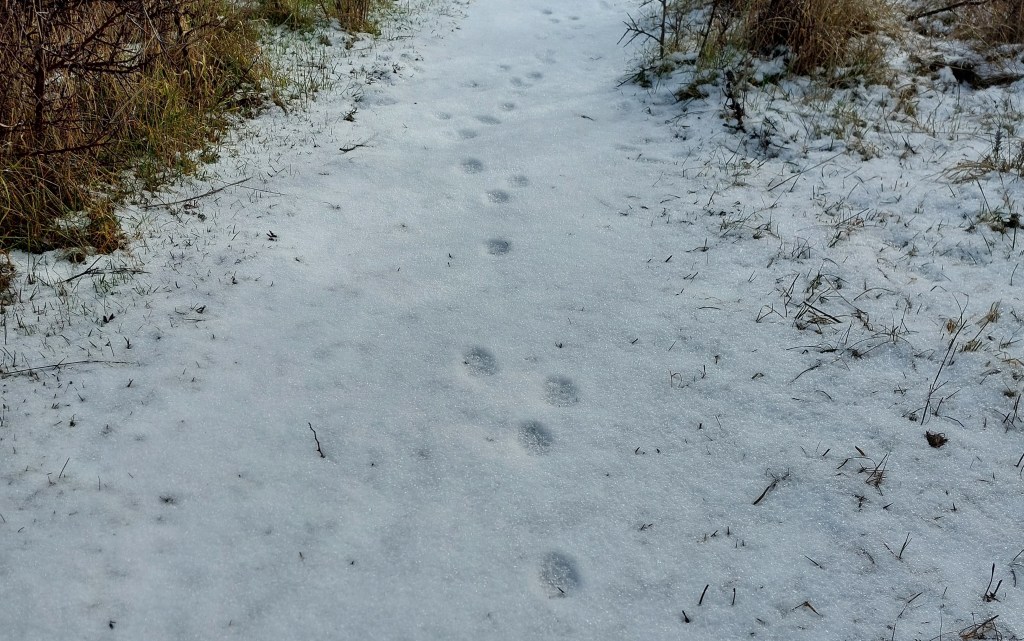
Small prints – maybe deer, goats, or sheep?
Midsized prints – maybe dogs or lynx?
A hoof-style print – maybe boar?

I felt a tender spot for these tiny animals seeking shelter and food off this windswept peak. Their footprints and a bit of scat along the way are really all that these creatures seem to leave behind. Insignificant, temporary calling cards.
As we crested the peak we saw a looming white radar structure, which serves the local civilian airspace. It’s an alien sight up there: a giant bright ball against an otherwise untouched landscape. As we approached, the path became a paved road, the rocks became bricks, the open spaces transitioned to fences with barbed wire across the top.
Clearly, we human animals leave a much more significant footprint.

And isn’t that just the case? Throughout the history of the world, species have come and gone leaving very little behind. A fossil here, a tar pit there.
Humans leave a scar almost everywhere we go. We’ve forgotten how to live in harmony with the land. How to honor its gifts and how to exit with grace.
Sadly, we stumble even when we try our best.
In the late 1800s, spurred by the conservation efforts of President Theodore Roosevelt along with many artists, writers, and activists, the US began setting aside national parks and forests to keep them safe from development and exploitation. The US Forest Service was established to oversee the management and usage of these lands.
However, the “management” of these lands faces significant challenges.
As of 2018, according to the US Department of Agriculture, the US Forest Service has issued over 7,000 leases to private energy and mineral mining companies covering five million acres of federal lands (https://www.usda.gov/media/blog/2018/05/21/many-benefits-energy-development-forest-service-lands).
Most of us have heard of the now extinct Keystone XL pipeline. This toxic crude pipeline was a proposed shortcut through Montana, South Dakota, Nebraska, Kansas, Oklahoma, and Texas. In addition to cutting through waterways and grasslands in Native American tribal lands, it was a devastating threat to agricultural lands, key aquifers, and public parks.
After President Obama vetoed the pipeline’s permits, Trump used executive order to reinstate the permits. In the first days of the Biden administration, the permit was rejected again and the company decided to stop the project permanently.
Good news, right? Well, sort of.
We forget that the original Keystone pipeline still exists (Keystone XL was its next generation). Today it still actively pushes highly toxic tar sands east through Canada and south through the mid-section of the US, traversing private and public lands.
This notoriously “nasty crude” is highly acidic and corrosive. Thus, these pipelines leak frequently, devastating local communities and native plants and animals, as it did on the Kalamazoo River in 2010 (see footnote).
There are pipelines like this everywhere. The American Petroleum Institute boasts that there are over 190K miles of liquid petroleum pipelines in the US as well as 2.4 million miles of natural gas pipelines. Most, they claim, are “safe” but the footprint and potential latent affects are present.
So glad we are protecting these our natural spaces from development.
Last year I participated in a book club moderated by the book’s author, Justin Farrell, a professor at the Yale School of the Environment. Billionaire Wilderness, The Ultra Wealthy and the Remaking of the American West chronicles Farrell’s extensive research on usages of private land trusts as a method of preservation in Teton County, Wyoming.
Farrell found that many of these trusts have been critical to saving native plants and animals. However, this lever is also being exploited by some wealthy individuals to shift their money to low tax areas to conserve financial, as well as natural, resources.
And here’s where it gets tricky: True, these land trust block access to pristine parts of nature to most people. Yet they allow access to uber wealthy by circumventing “development” regulations and loopholes to construct exclusive private ski and outdoorsman clubs, like the Yellowstone Club. The ramifications to indigenous peoples, to plants and animals – as well as the impact on citizens in the neighboring community are significant.
So, is this altruism? Conservation for the few?
Somehow, we humans can’t seem to get out of our own way.
It’s easy to feel disheartened. In truth, I have a hard time imagining a path where humans return to their rightful diminutive place among the animals. Even if humans evaporated tomorrow, the long tentacles of our impact would extend millennia into the future. Some external force greater than all of us combined would need to bring about the amount of change required.
But we can’t lose hope because small changes also reverberate.
As it often does, it comes down to each of us making choices every day to lessen our footprint. Be informed, get involved. Utilize the power of your vote. Use less stuff and know the ingredients of what you use. Reuse that paper bag. Push your local government to expand recycling and the processing of plastics. Cut down on animal products.
We all know the drill.

I believe that was the lesson I was meant to reflect on today. I can increase my awareness. I can take steps in my own life that reduce my footprint to just that…a footprint.
And so can you.
Bisous,
Hanna
What was the 2010 spill into the Kalamazoo River in Michigan?
Over the course of 18 hours a 6-foot rupture in the pipeline released over a million gallons of toxic sludge into a tributary of the Kalamazoo River, wiping out fish and shore animals, displacing people, destroying food sources and cultural heritage sites of two native American tribes. Clean up has been ongoing and the environmental impact is nearly impossible to know conclusively.
The second largest inland oil spill in our history and most of us have never heard of it.
Learn more: https://kalamazooriver.org/learn/what-are-the-problems/oil-spill-2/
 40 Weeks in France
One response to “Ce que nous laissons derrière”
WOW!
<
div>Th
LikeLike