
It was a true planes, trains, and automobiles moment. Back in the US and trying to fly from LA to Portland on Christmas Eve (which I don’t recommend!) we looked at the flights ahead of us.
Canceled
Canceled
Delayed 2 hrs
Great. But I was determined to get home to see my family for Christmas, so we dutifully waited at LAX while our flight was delayed later and later and then…voilà!
Canceled.
The next flights weren’t leaving LA until the 28th – and given that our flight back to France left on the 30th, this didn’t seem like a solution.
My amazing husband nodded and while I stuck out the 2.5 hour line at customer service, he took the boys, gathered our luggage, and rented a Dodge Ram truck for the 925 mile drive north.
He’s a patient man. I’m stubborn as heck, and he’s a patient man.
We’ve actually done that drive twice before as a family. During COVID we twice rented a large RV and drove to Oregon to spend a couple of weeks with my parents. That was summertime and there was a lot to see along the way.
This was a different deal. By the time we finally left the airport, it was 4:30pm and the sun was heading for the horizon. Just past Bakersfield we encountered a massive wall of fog, appearing in waves so thick that in places we couldn’t see much beyond 15 feet in any direction.
At multiple points we slowed to about 30 or 40 mph just to ensure we were staying within the lane lines and not smashing into anything ahead of us. In that fog your eyes start to play tricks on you and you begin to wonder what planet you’re on.

Mid next morning somewhere along the central California interior, the fog began to break. It was delightful to start to see what you have been driving past – rows upon rows of hazelnut trees, mostly, and fallow fields stretching back into the lingering fog.
It was surprising to see such an unreal barren landscape. During our summer drives, these fields were filled with rows of lettuce, bulbous berry bushes, groups of workers bent low against the hot sun, and weblike networks of irrigation lines. Now it was a sea of grey frosted ground and scraggly trees intermixed with the fingers of the fog as it tried to hang on those last few miles.
I grew up in the Pacific Northwest – the land of evergreens. Mountains of fluffy green trees that withstood all the seasons. Its not that I haven’t seen deciduous trees, its that I never really paid much attention to them. They just seemed like empty blotches amid the otherwise verdant landscape.
These barren skeletons we passed on the highway just seemed to be creatures in a state of lack. They were pointy, disagreeable, hard to look at.
And then it dawned on me. These trees are anything but lifeless and drab. In fact, going on inside these apocalyptic forests arranged in unnatural man-made rows is a process worth honoring.
Dormancy.
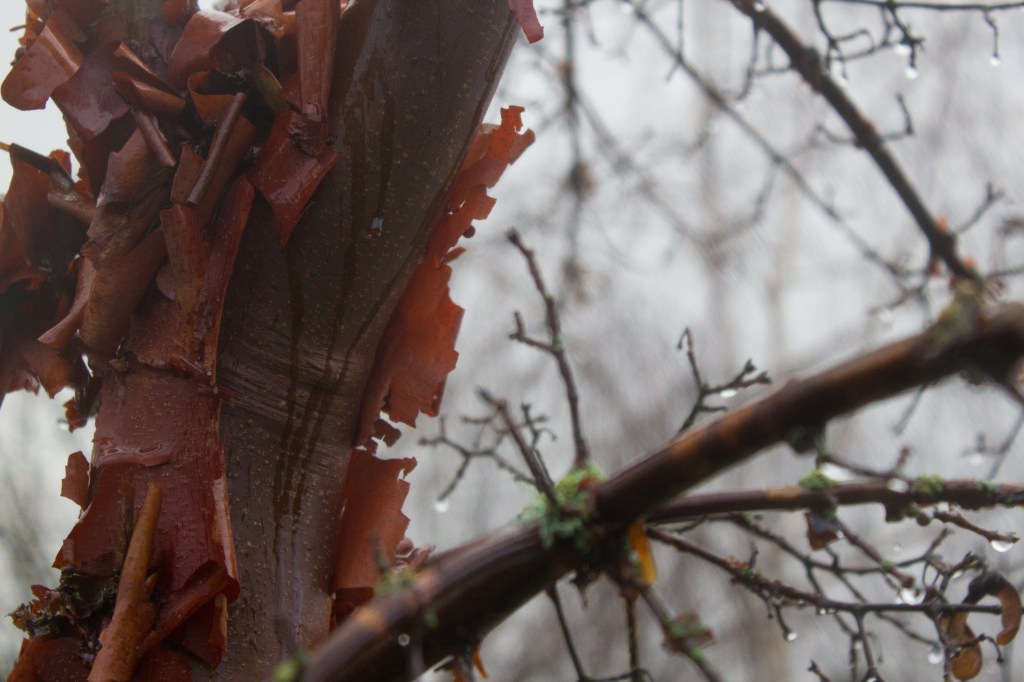
What we simply call “fall” is a beautifully choreographed dance within each plant. Spurred by the reduction of infrared light, trees reorient themselves. Growth slows to compensate for potentially reduced liquid ground water and nutrients as the soil cools and freezes. The flow of sap concentrates in the larger limbs and trunks. Leaves are lost and the buds left in their place develop protective hard scales.
Then winter comes and what seems bland to us, is anything but. Hormones in the trees create special “antifreeze” proteins that sit in the intercellular spaces to absorb water and prevent the damage that ice causes the fragile cell walls. And while growth above ground ceases, below ground the root system is foraging and expanding to find new nutrients and favorable foundations.
And then spring –
After a long period of critical dormancy, bud burst ensues and the trees explode into leafy, lovely flowers and fruit.
While dormancy might only be seen as waiting out poor environmental conditions, it is actually a critical phase in the annual maturation of a tree. Without dormancy’s gifts of nutrient concentration, root growth, and natural pruning, the bud burst phase and subsequent fruit production is severely weakened.
And this isn’t just for trees.
In my own personal and professional life, dormancy hasn’t been valued. It has been equated to laziness, weakness, or lack of drive.
As a strategy consultant, for years it surprised me that just as the daylight lessened and our thoughts turned to home and hearth, our busiest period would descend the weeks preceding December 31st. Mergers and acquisitions to complete before the end of the fiscal period; new clients to land to ensure a pipeline for the following year.
All of this is ok, if it just meant a delayed dormancy. But it never did. Come January 1st, the projects started afresh with integration and cost cutting work. Growth and strategy projects landed like a thud on my desk. And I knew that I either sank or swam.
Which is one of the reasons I decided to pull myself out of the water.
Growing up in a capitalistic society, productivity is the #1 marker of our success. How many hours did you work? How much vacation time did you build up vs. actualy use? How many after-school activities can you fit on the schedule? Maybe I can wake up at 5am to find a sliver of time for myself?
And in all of this we have lost the honor we give to our own dormancy.
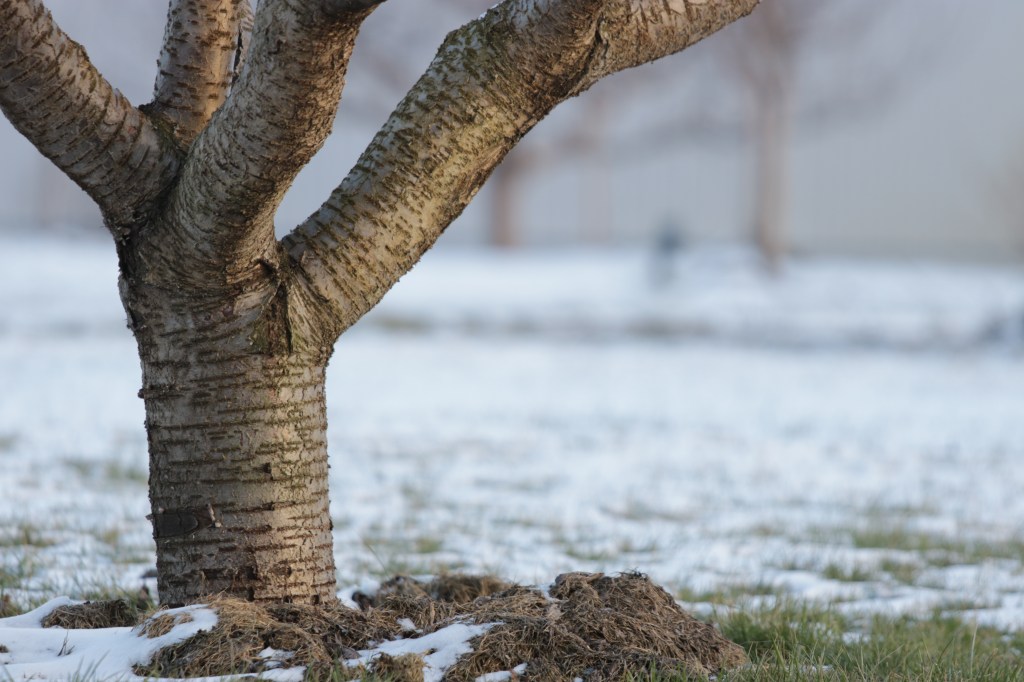
But these scraggly deciduous trees are living proof of our deep need to flow with the seasons of our lives. To reorient our resources internally and tend to the wounds that hold us back. To draw the curtains closed and welcome a bit of quiet and darkness with acceptance, curiosity, and rest.
Just to be clear, I’m not referring to the oft-touted “self-care” movement. This has its place for sure, but dormancy has a deeper resonance. An extended period of pause – not just physically, but in our spiritual and creative realms as well.
So, in this month of January, when we are often quick to move from the exhausting hustle of the holidays directly into the tantalizing pull of new year resolutions, goal setting, and doing, maybe we resist and instead hit the pause button.
Maybe we can tend to our roots and let what grounds us dig even deeper to discover new paths to nurture and support us. Maybe we can ebb and flow with the internal signals that we have evolved to protect us. Maybe we can rest when we need to rest. Maybe we can allow our buds to build up their strength and dream with more brilliance.
And when spring comes, we too can burst forth with all the splendor and fragrance that sets the world on fire.
Bisous,
Hanna
 40 Weeks in France