
Our immigration consultant asked me for evidence of “stabilité de votre résidence” and I had to chuckle.
Obviously, proof of residential stability is a necessity for official documents, but the irony of our situation was clear. Here we are: a family that just rid itself of almost everything it owned, packed the rest in 6 bags and 5 boxes, left established friends and dear family, crossed a continent and an ocean, and moved to a village previously seen only once before.
Stability?
If anything, we are evidence to quite the contrary.
Instability used to bother me more than it does now, I guess. Bobby and I had countless discussions about buying a house where we could grow old. We went to great lengths to pick an elementary school for our children that would take them through high school graduation. We bought cars that would last and considered investing in equity club memberships that would amortize.
We had wandered enough in our youths, and now we should settle down. Right?
Looking back on my last 20 years in Los Angeles, the various vestiges of stability that we did claim weren’t really all that gratifying. Our neighbors were just a few feet away – and had the ability to look right into our bathroom window when the trees were pruned adequately. The school was constraining and rigid. Our commitments and memberships felt like handcuffs.
We were stifled – horses yearning to break free of the tether. So, we blew it all up and walked away.
Now I’m not thumbing my nose at stability – it has its place and its purpose. Stability provides predictability, and permits us to build traditions and community. It allows us to make plans and organize ourselves. It is comfortable, known.
Yet the price of stability is worth acknowledging too.
One of my favorite sections of Walden or, Life in the Woods by Henry David Thoreau is a section in the first chapter where he is critical of what we accumulate in our desire for stability. He writes:
“How many a poor immortal soul have I met well-nigh crushed and smothered…creeping down the road of life, pushing before it a barn seventy-five feet by forty…and one hundred acres of land, tillage, mowing, pasture, and wood-lot. The portionless, who struggle with no such unnecessary inherited encumbrances, find it labor enough to subdue and cultivate a few cubic feet of flesh.”
Were we as humans meant to be weighed down with so much stability and obligation? Or were we meant to wander – defining our stability and strength within the depth of our souls? Which of these permits us the greatest expansion?
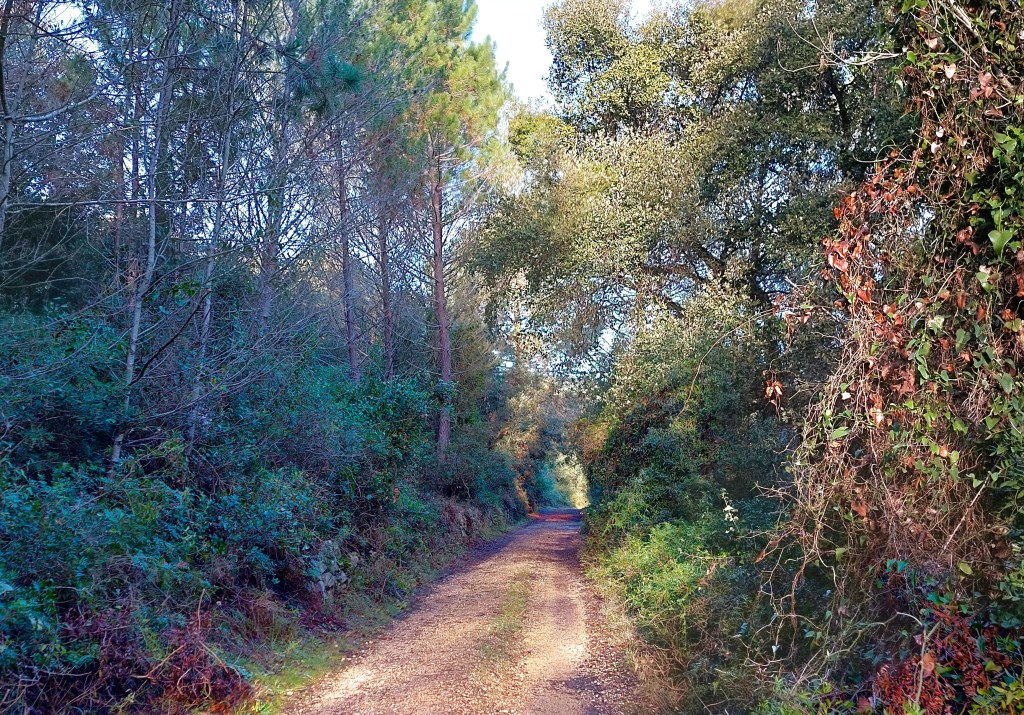
This week we hiked a series of old roads and sheep trails in an area next to Grasse, another fairytale-like citadel in the Alpine foothills. The fertility of the soil is perfect for flowers, making Grasse the perfume capital of the world.
Built firmly into the hill, the village’s views of the Côte d’Azur are breathtaking. The stability of this 11th century village built in stone is undeniable.
Yet, Grasse has always been a place of movement and trade. First with leather products and then with perfumes and more modern industry. All the while the ancient serpentine paths and roads around Grasse have carried more than just goods: ushering along ideas, culture, food, life.
The beauty of humanity in a constant state of motion.
The main regional trail winds along La Route Napoléon, the road Napoleon Bonaparte took to avoid areas that supported the royal coalition. Splintering out in all directions are paths carved among the huge boulders and over hills. Deep ruts worn into the ground by years of comings and goings.
With this backdrop, it seems to me that we as a humanity are born with a deep pull to move about. Nomads exploring our terroir. Fellow journeymen changing, adapting, and sharing. Creating something new and unexpected.

I think back to the request from our consultant. I wonder what evidence would prove our human-ness if this way of living in motion were the goal rather than the accumulation of things in one place?
Perhaps if “stability” was something written in our souls instead of on our mailbox or utility bills.
Maybe one could create a dossier outlining the places we’ve been and the miles we have walked. Perhaps, the ways we have faced adversity and been transformed. Examples of where we showed determination to machete a new path when one was undefined. Moments when we paused long enough to bask in both the sunrises and the sunsets.
It does sound foolish, but is it?
Maybe through this lens, we would recognize that we’ve been perfectly instable all along.
Bisous,
Hanna
 40 Weeks in France
One response to “Stabilité”
Hanna,
<
div>This is thoughtful and wonderfully expressed. Stability is relative and individual! A refugee sees it differently than someone whose family has generations of stability. We Jewish peop
LikeLike