
We live in a village named Mougins. They call it a commune, but not in the way that Americans might use the term, as in: “I’ve sold all my earthly possessions and am now living in a commune!”
Oh wait…we did that so maybe not the best comparison.
Ok, well here, the commune means something different. The commune of Mougins is the building block of the community and many families have lived here generations. It is more than an address; it is their home. It is a meeting place for people of all ages, where one can venture out into the world and then come back to a place “where everybody knows your name”.
I can feel that sense of community every time I walk into the boucherie or paperie (yes, they have special stores for paper). I see the same proud local faces every day. They stop what they are doing and want to get to know us and our story. They want to share their experiences and be a part of ours. They want to truly know their new neighbors.
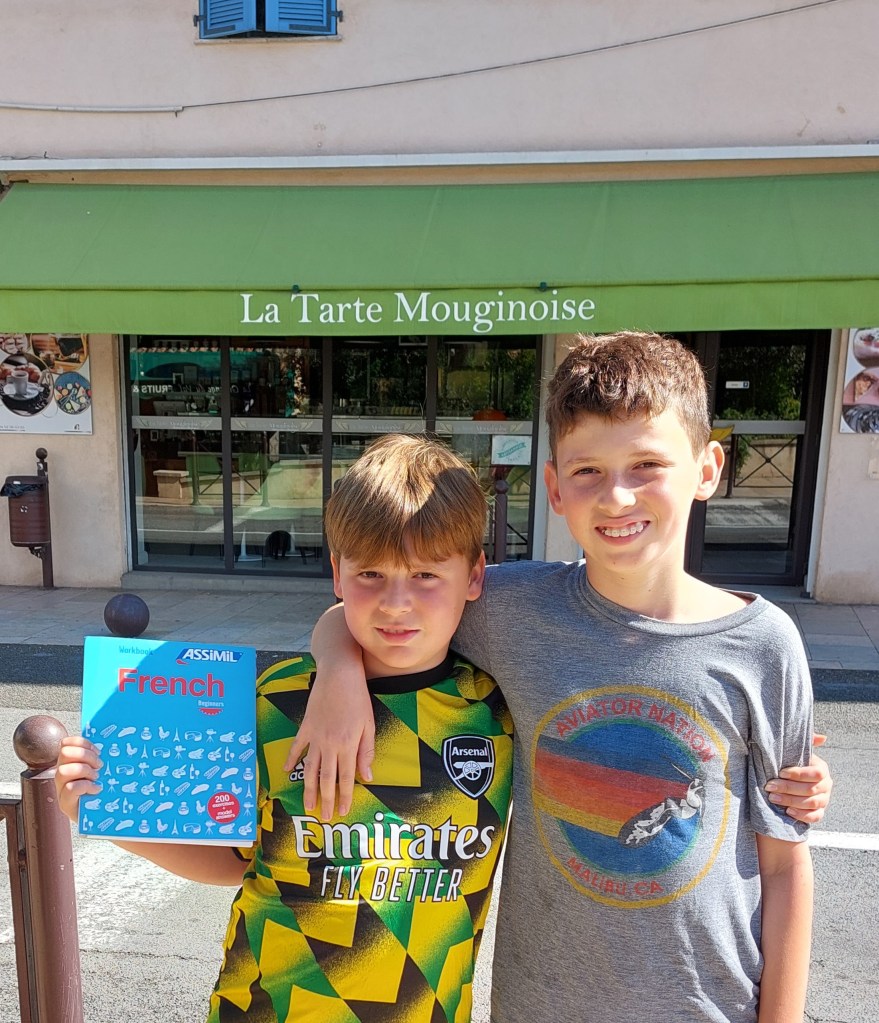
The commune is also a part of the identity they carry, and they carry it with care and intention. A place isn’t just the Mougins Bakery. It is La Tarte Mouginoise. It sounds poetic and almost mythical – you just have to slow down to drink in the fullness of those words – and taste each sweet syllable along with the mouth-watering pastries behind the glass cases!
We recently had the distinct pleasure of meeting Ève and her husband Stéphan in Mougins old village (le vieux village). Ève is a stunningly beautiful and commanding woman who you can see has a special spirit. They run a marvelous gourmet shop in the commune, called l’Epicerie Coste. Her passion is to curate delicious, organic foods from small producers in the local region. Not surprisingly, we have become big fans of hers.
Ève told us that she knows California well (our California accent betrayed us quickly at our first meeting). She was previously a professor in the medical robotics department at Stanford for many years. While she loved Palo Alto, she felt the call to come home and refocus her life away from the busy demands of the city. She returned to live in the old stone building that had been in her family for generations and open the épicerie in the storefront below.
You can tell that she made the right choice from the light that practically emanates from her as she moves about the small terrace or ducks her head out of the upstairs window to check on us at our table while she makes dinner. She has followed her heart and does things that bring her joy and nurture her creativity. Her story thrilled me and confirmed that maybe what we are doing isn’t so crazy after all.
We met Ève while I was taking Bobby to see my favorite place in Mougins. Near the center of the commune is a stately old stone church which dates to the 11th century, when the monks set about constructing a fortified village on the hill. They call her the Parish of Saint-Jacques-le-Majeur, who was a rather stern-looking fellow if the paintings of him are to be believed. But the interior of the parish is really charming.

The parish was enlarged in the 18th and 19th centuries, and the village added a tall bell tower that dutifully chimes out each quarter hour with a single deep peel.
So, now I would like you to meet my new love interest:
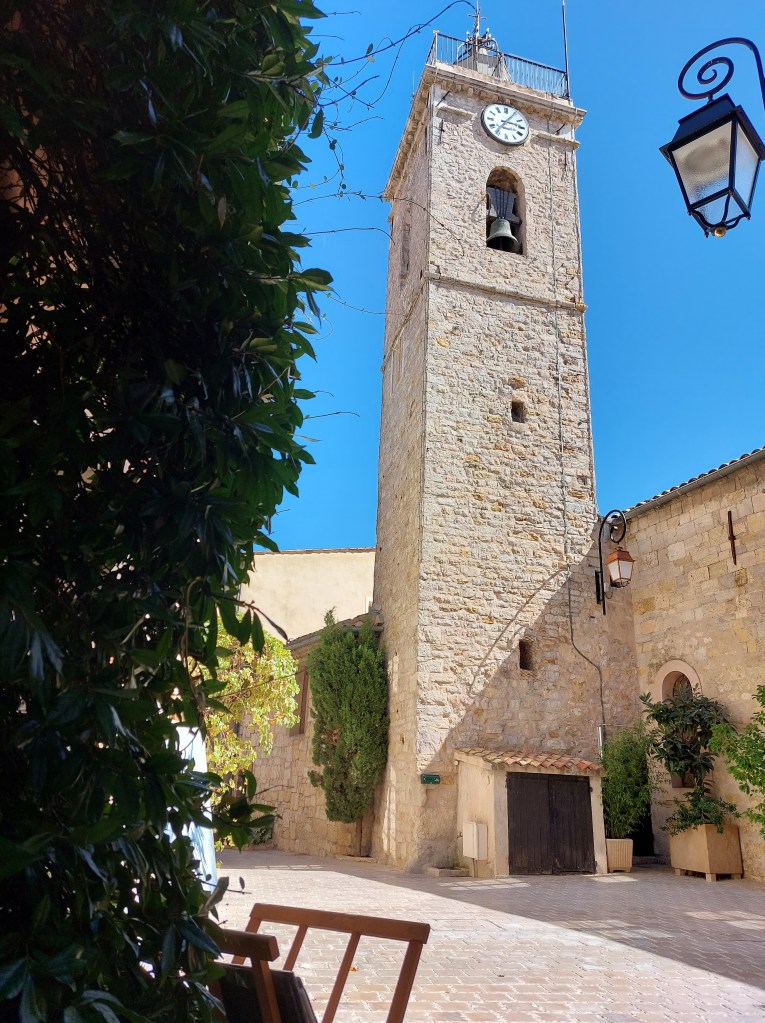
The Bell Tower (le clocher!). It’s ok, Bobby is aware.
This bell tower calls to me. She harkens to a part of my ancient soul and connects me to the history of the place and her people. I’m not crazy – I know that this story isn’t really mine. 23&Me suggests that little if any of my DNA is French. And yet, when I graze my hand along the rough stones, I can somehow feel the women and men who toiled to build her in a world before industrialized tools. Those who climbed her curving stairs to ring the bell daily or to mark the end of occupation. Those who uttered quiet prayers and who sought her as a refuge from pain and a source of hope. I can almost see their faces in the shadows.
And so, I find myself sitting at her feet for hours, or taking a side trip up the narrow streets just to gaze for a moment, or telling my children an odd fact about her at dinner (come on, ma…again?!).

She is beautiful. She rises straight and tall above the village. She is the landmark we look for as we head for home each day. She has remained proud and steady through 300 years of storms, wars, and revolution. Her bell has a perfect patina and the sound it makes is heavenly. She has a small metal promenade at the top (probably a later addition) and dotted along her edifice are a few pieces of rough-hewn iron as decoration. A more recent addition is the lovely, curved wrought iron lamp post at her base which boasts the coolest copper gas lamp. Sigh…what could be better?
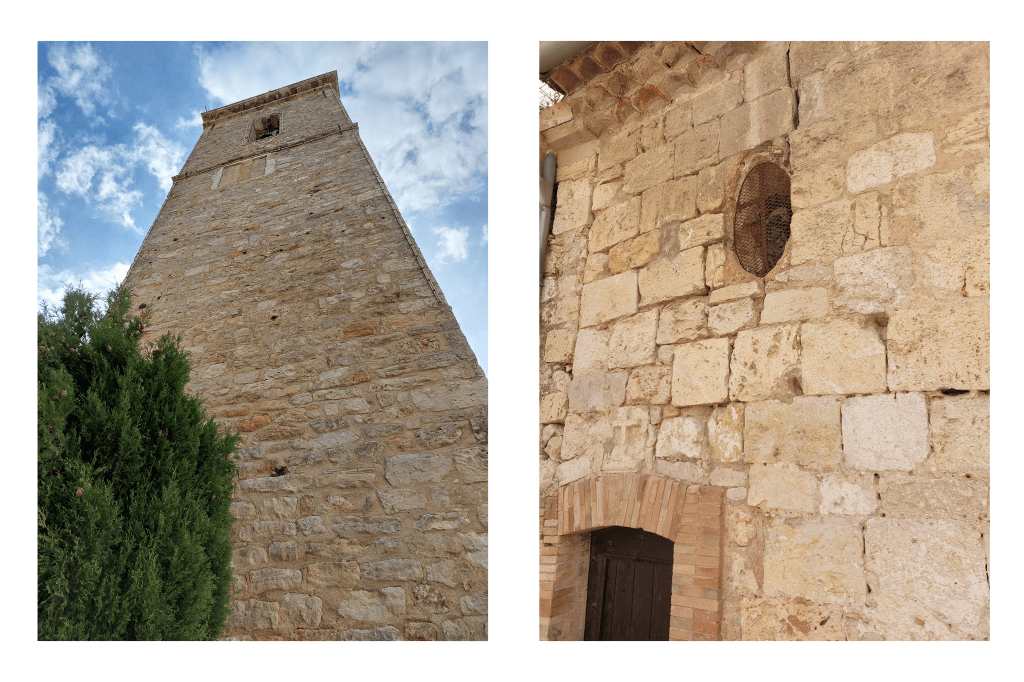
Despite her fortitude, if you look at her long enough – study her with the longing eyes of an admirer – you begin to see her precious faults. Many of the stones in her walls are misshapen and mismatched. There is a crack in the mortar here. A fragment of stone is missing along her balustrade. A bit of water damage marked with dark spots under the tile roof. She has unattended dank places too deep in the bell stand to be cleaned, in maybe a century. At some point, a mason filled in a broken window on her face. But the character and color of the stone wasn’t a perfect match – so she has a slight scar with a lost story to tell.
I chuckled when I first noticed that her clock had been perpetually stuck at 3:05 since we’ve moved here – frankly it’s probably been that way for a while. I love checking to make sure the time is still wrong when I pass her. To me it is a reminder that this human concept of time actually isn’t that important in the grand scheme of things. It echoes the way she takes life as it comes. It doesn’t matter that people stop only for a few moments to glance up and see her (or maybe not see her at all). She doesn’t care.
Maybe that is what draws me in like a moth. How she embodies the wisdom that she has earned over time. How she wears her beauty and blemish without embarrassment or shame. How she unapologetically faces out into the world with determination to be herself.
And how the sum of all of her is breath-taking.
Isn’t that how we all seek to exist?
Bisous,
Hanna
 40 Weeks in France